quinta-feira, 5 de maio de 2011

Google at CHI 2011


Cross-posted with the Technical Programs and Events Blog

Google has an increasing presence at ACM CHI: Conference on Human Factors in Computing Systems, which is the premiere conference for Human Computer Interaction research. Eight Google papers will appear at the conference. These papers not only touch on our core areas such as Search, Chrome and Android but also demonstrate our growing effort in new areas where HCI is essential, such as new search user interfaces, gesture-based interfaces and cross-device interaction. They showcase our efforts to address user experiences in diverse situations. Googlers are playing active roles in the conference in many other ways too: participating in conference committees, hosting panels, organizing workshops and teaching courses, as well as running demos and 1:1 sessions at Google's booth.

This year's CHI takes place in Vancouver, BC, from May 7th - 12th.

PAPERS

User-Defined Motion Gestures for Mobile Interaction
by Jaime Ruiz, Yang Li*, Edward Lank

Experimental Analysis of Touch-Screen Gesture Designs in Mobile Environments by Andrew Bragdon, Eugene Nelson, Yang Li*, Ken Hinckley

Many Bills: Engaging Citizens through Visualizations of Congressional Legislation by Yannick Assogba, Irene Ros, Joan DiMicco, Matt McKeon*

YouPivot: Improving Recall with Contextual Search by Joshua Hailpern, Nicholas Jitkoff*, Andrew Warr*, Karrie Karahalios, Robert Sesek, Nik Shkrob

Oops, I Did It Again: Mitigating Repeated Access Control Errors on Facebook by Serge Egelman, Andrew Oates*, Shriram Krishnamurthi


WORKSHOPS
Crowdsourcing and Human Computation: Systems, Studies and Platforms by Michael Bernstein, Ed H. Chi*, Lydia B. Chilton, Björn Hartmann, Aniket Kittur, Robert C. Miller

PANELS
Designing for User Experience: Academia & Industry by Joseph 'Jofish' Kaye, Elizabeth Buie, Jettie Hoonhout, Kristina Höök, Virpi Roto, Scott Jenson*, Peter Wright

Festschrift Panel in Honor of Stuart K. Card by Ed H. Chi*, Peter Pirolli, Bonnie John, Judith S Olson, Dan Russell*, Tom Moran

CHI Should be Replicating and Validating Results More: Discuss by Max L. Wilson, Wendy Mackay, Ed H. Chi*, Michael Bernstein, Dan Russell*, Harold Thimbleby

Transferability of Research Findings: Context-Dependent or Model-Driven by Ed H. Chi*, Mary Czerwinski, David Millen, Dave Randall, Gunnar Stevens, Volker Wulf, John Zimmerman

The Future of Child-Computer Interaction by Allison Druin, Gary Knell, Elliot Soloway, Dan Russell*, Elizabeth Mynatt, Yvonne Rogers

CASE STUDIES
From Basecamp to Summit: Scaling Field Research Across 9 Locations by Jens Riegelsberger*, Audrey Yang*, Konstantin Samoylov*, Elizabeth Nunge*, Molly Stevens*, Patrick Larvie*

COURSES
Design and Analysis of Large Scale Log Studies by Susan Dumais, Robin Jeffries*, Dan Russell*, Diane Tang*, Jaime Teevan

SIG MEETING
Participatory Culture in the Age of Social Media by Dana Rotman, Sarah Vieweg, Sarita Yardi, Ed H. Chi*, Jenny Preece, Ben Shneiderman, Peter Pirolli, Tom Glaisyer

Note: * denotes a Googler

quarta-feira, 27 de abril de 2011

Beyond Claiming Your Place Page

(Cross-posted from the Google Places Blog.)

Last week, we invited a group of public relations and social media professionals to Google Austin to introduce them to the range of features offered as part of Google Places. Most of the attendees were experts on the basics (for instance, claiming a Place page), but many were surprised to learn about the other ways Google Places can help them connect with their customers.

The Dashboard

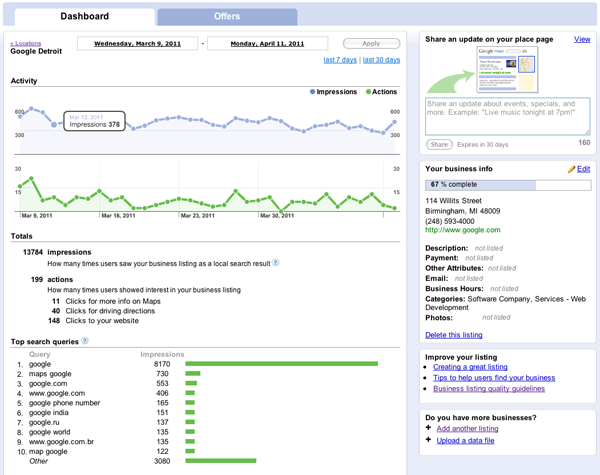
Once you’ve claimed your Place page, you can see detailed analytics on a handy dashboard, including information on the number of time your Place page was viewed (impressions) and the search terms your customers use to find you:


Ratings and Reviews

Customers can rate and review the places they go through Google, offering valuable feedback about what they liked and didn’t like about their experience. This information appears on the Place page for a business. Business owners also have the ability to respond to those reviews publicly — a great way to engage with customers and show you’re listening to their feedback. Once you claim your Place page and you’re logged in, you’ll see the option to respond to individual reviews.

Sharing Your Expertise

Beyond encouraging customers to rate and review their businesses via Google Places, attendees at our Austin Tech Talk also discussed how they could set up their own Google Places profile for their business to rate and review, as a way to show their community involvement and local support. Here’s what came out of a brainstorming session:

  • Restaurants could rate and review local farms, farmers markets, and artisans to show that they are using local ingredients.
  • Hotels could rate and review local attractions that may be of interest to their guests, or use their profile to provide their concierge with a “cheat sheet” of useful info.
  • Gyms could rate and review local restaurants to point out the healthiest menu items for their members so that they can reach their fitness goals.

These were just some of the many ideas that were shared!

Google Places Business Kit

The most talked-about topic of the night was the Google Places Business Kit, a box of info and schwag that business owners can request, detailing how they can better interact with their customers on Google. Some of the items a business owner can request include after-dinner mints and Place pin–shaped coffee stirrers, to remind and encourage customers to rate and review that business on Google.


What are some of the ways you’re using Google Places to connect with your customers? Learn more by visiting our Google Places Help Center.

Posted by Whitney Francis, Austin community manager

quarta-feira, 20 de abril de 2011

Next Stop: San Diego, California

(Cross-posted on the Google Places Blog.)

Every day, more and more users are looking online for local information — where to eat, where to stay, where to shop. Online is where business owners need to be too. So for the past several months, we’ve launched marketing campaigns promoting our core local product offering Google Places in five cities: Portland, Austin, Las Vegas, Madison and Charlotte. In each of these cities, we’ve been working closely with local business owners, showing them how Google Places can help them get found on Google and connect them with their customers.

We’re excited to announce that the next campaign is hitting San Diego, California, today — our largest city to date!

With more than 77,000 local businesses, San Diego is the perfect next city in our campaign to help local businesses get noticed on Google. Plus, with nearly three million residents and more than 30 million tourists visiting the city annually, we see a great opportunity to help locals and tourists alike share and discover great San Diego businesses online.

Over the next several weeks, we’ll be working with business owners in a bunch of ways:

  • A team of Google reps will be visiting businesses with information about how to claim their Place page and keep their information up to date. They’ll also highlight how business owners can encourage their customers to rate and review their business on Google and share those recommendations with their friends.
  • Business owners who have verified their free Place page can request a Google Places starter kit. Visit googleplacescatalog.com for more information. Part of this kit is our “Recommended on Google” sticker, which utilizes NFC technology to enable users with smartphones, such as the Nexus S, to see more information about that business and easily rate and review it right then and there.
  • Businesses eligible to participate in a beta for Google Boost — our online advertising program — will receive $100 coupon offers to get started.

If you see us around town, say hello! We look forward to working with San Diego’s amazing community of business owners.

Posted by Sameer Mahmood, Local Marketing Team

Helping America’s startups grow

[Cross-posted from the Official Google Blog]

Every business starts out small—whether with an idea or the hanging of a shingle outside an office or storefront. Even Google was once a small business, operating out of a garage in Menlo Park, Calif. We’re proud of our success, but we’re even more proud of the role we’ve played helping a lot of other businesses grow. In fact, in 2009 Google search and advertising tools
generated $54 billion of economic activity in the United States.

To further help new American businesses create economic growth, today we’re announcing a commitment of up to $100 million to the
Startup America Partnership—an alliance of the country's most innovative entrepreneurs, corporations, foundations and other private sector leaders—for companies to promote their business with Google advertising over the next year.

Startup America participants will be able to use Google advertising platforms like
AdWords and Boost and receive a $1,000 Google match for $1,000 spent between June 1, 2011 and June 1, 2012. Our chief economist Hal Varian has calculated that businesses make an average of $2 in revenue for every $1 they spend on AdWords, so we think this commitment will be especially powerful.

If you are (or know of) an entrepreneur that’s interested in getting involved with the Startup America Partnership, you can visit its
Resource Center for more information. Our goal as a participant in this national initiative is to help entrepreneurs grow amazing businesses, and we believe our commitment will help them do it.

sexta-feira, 15 de abril de 2011

An Update on Tags

[Cross-posted from the Google LatLong Blog]

As users increasingly rely on tools like Google Maps and Places for information about the world around them, we're working hard to develop products that help local businesses highlight themselves and their offerings.

Last year, we introduced our trial for Google Tags, a way for businesses to highlight their organic Google Places listing with a yellow tag that showcases offers, photos, videos, menu, and reservations for a flat monthly fee.

Since that experiment began, tens of thousands of businesses have used Tags to help potential customers make easier, more informed decisions when searching. Throughout this period, we monitored Tags closely to learn more about our users' business needs and how they used the product.

We’ve made a decision to shift our efforts toward other present and future product offerings for local businesses, and will be discontinuing this trial. To that end, we’ve now halted new signups and will be working with existing participating businesses over the coming weeks to help them meet their marketing needs with other Google products where possible.

We’ve learned a lot from our Tags trial and will take that knowledge into account as we continue to find the best ways to serve users and local businesses alike. Lastly, we want to thank all of the businesses that were part of our Tags trial, and we hope we can meet their advertising needs with one of our existing products.

Posted by Shalini Agarwal, Product Manager

quinta-feira, 14 de abril de 2011

Partnering with Tsinghua University to support education in Western China


We’re excited to announce that we’ve teamed up with Tsinghua University to provide educational support to five major universities in Western China: Qinghai, Xinjiang, Guizhou, Ningxia, and Yunnan. Together, we aim to:
  • Support faculty development by recognizing outstanding teachers, sponsoring published papers, and funding academic exchange and cooperation with other universities
  • Establish specialized curricula by creating new courses focused on advanced industrial and web technologies
  • Cultivate student talent by inspiring scientific and technological innovation through local activities and programs.
A ceremony held at Tsinghua today kicked off what we expect to be a long and beneficial partnership to advance educational opportunities in the region.

quinta-feira, 7 de abril de 2011

1 billion core-hours of computational capacity for researchers


We’re pleased to announce a new academic research grant program: Google Exacycle for Visiting Faculty. Through this program, we’ll award up to 10 qualified researchers with at least 100 million core-hours each, for a total of 1 billion core-hours. The program is focused on large-scale, CPU-bound batch computations in research areas such as biomedicine, energy, finance, entertainment, and agriculture, amongst others. For example, projects developing large-scale genomic search and alignment, massively scaled Monte Carlo simulations, and sky survey image analysis could be an ideal fit.

Exacycle for Visiting Faculty expands upon our current efforts through University Relations to stimulate advances in science and engineering research, and awardees will participate through the Visiting Faculty Program. We invite full-time faculty members from universities worldwide to apply. All grantees, including those outside of the U.S., will work on-site at specific Google offices in the U.S. or abroad. The exact Google office location will be determined at the time of project selection.

We are excited to accept proposals starting today. The application deadline is 11:59 p.m. PST May 31, 2011. Applicants are encouraged to send in their proposals early as awards will be granted starting in June.

More information and details on how to apply for a Google Exacycle for Visiting Faculty grant can be found on the Google Exacycle for Visiting Faculty website.