quarta-feira, 29 de junho de 2011

“Mobile”-ize your business with Google Sites

By the end of this year, it is predicted that over half of all Americans will own a smartphone. With 51% of consumers more likely to purchase from retailers that have mobile-optimized sites, is your website ready to take on this growing mobile trend? We understand that time is the most valuable resource for a small business owner, so to help you save time, we’re launching a new tool: Google Sites mobile landing pages. With Google Sites mobile landing pages, you can build a professional mobile landing page for your business in minutes, for free -- and without any coding experience.


You can set up your mobile site in just a few steps:
  1. Visit sites.google.com/mobilize.
  2. Choose from one of five templates for your site or start with a blank template.
  3. Choose a site name and URL.
  4. Give your site a description to make it easier for people to find.
  5. Choose whether you want your site to be visible to everyone or only certain people.
  6. Add text, images, buttons and gadgets to your site to help personalize it and deliver your message.
Watch the video below to see how easy it was for small business owner, Bob, to mobilize his business with Google Sites:


To get started, visit
sites.google.com/mobilize, and see how going mobile can boost your business!

Posted by Shiv Kumar, Google Mobile Specialist

terça-feira, 21 de junho de 2011

Google Translate welcomes you to the Indic web


(Cross-posted on the Translate Blog and the Official Google Blog)


Beginning today, you can explore the linguistic diversity of the Indian sub-continent with Google Translate, which now supports five new experimental alpha languages: Bengali, Gujarati, Kannada, Tamil and Telugu. In India and Bangladesh alone, more than 500 million people speak these five languages. Since 2009, we’ve launched a total of 11 alpha languages, bringing the current number of languages supported by Google Translate to 63.

Indic languages differ from English in many ways, presenting several exciting challenges when developing their respective translation systems. Indian languages often use the Subject Object Verb (SOV) ordering to form sentences, unlike English, which uses Subject Verb Object (SVO) ordering. This difference in sentence structure makes it harder to produce fluent translations; the more words that need to be reordered, the more chance there is to make mistakes when moving them. Tamil, Telugu and Kannada are also highly agglutinative, meaning a single word often includes affixes that represent additional meaning, like tense or number. Fortunately, our research to improve Japanese (an SOV language) translation helped us with the word order challenge, while our work translating languages like German, Turkish and Russian provided insight into the agglutination problem.

You can expect translations for these new alpha languages to be less fluent and include many more untranslated words than some of our more mature languages—like Spanish or Chinese—which have much more of the web content that powers our statistical machine translation approach. Despite these challenges, we release alpha languages when we believe that they help people better access the multilingual web. If you notice incorrect or missing translations for any of our languages, please correct us; we enjoy learning from our mistakes and your feedback helps us graduate new languages from alpha status. If you’re a translator, you’ll also be able to take advantage of our machine translated output when using the Google Translator Toolkit.

Since these languages each have their own unique scripts, we’ve enabled a transliterated input method for those of you without Indian language keyboards. For example, if you type in the word “nandri,” it will generate the Tamil word நன்றி (see what it means). To see all these beautiful scripts in action, you’ll need to install fonts* for each language.

We hope that the launch of these new alpha languages will help you better understand the Indic web and encourage the publication of new content in Indic languages, taking us five alpha steps closer to a web without language barriers.

*Download the fonts for each language: Tamil, Telugu, Bengali, Gujarati and Kannada.

segunda-feira, 20 de junho de 2011

Auto-Directed Video Stabilization with Robust L1 Optimal Camera Paths


Earlier this year, we announced the launch of new features on the YouTube Video Editor, including stabilization for shaky videos, with the ability to preview them in real-time. The core technology behind this feature is detailed in this paper, which will be presented at the IEEE International Conference on Computer Vision and Pattern Recognition (CVPR 2011).

Casually shot videos captured by handheld or mobile cameras suffer from significant amount of shake. Existing in-camera stabilization methods dampen high-frequency jitter but do not suppress low-frequency movements and bounces, such as those observed in videos captured by a walking person. On the other hand, most professionally shot videos usually consist of carefully designed camera configurations, using specialized equipment such as tripods or camera dollies, and employ ease-in and ease-out for transitions. Our goal was to devise a completely automatic method for converting casual shaky footage into more pleasant and professional looking videos.


Our technique mimics the cinematographic principles outlined above by automatically determining the best camera path using a robust optimization technique. The original, shaky camera path is divided into a set of segments, each approximated by either a constant, linear or parabolic motion. Our optimization finds the best of all possible partitions using a computationally efficient and stable algorithm.

To achieve real-time performance on the web, we distribute the computation across multiple machines in the cloud. This enables us to provide users with a real-time preview and interactive control of the stabilized result. Above we provide a video demonstration of how to use this feature on the YouTube Editor. We will also demo this live at Google’s exhibition booth in CVPR 2011.

For further details, please read our paper.

quinta-feira, 16 de junho de 2011

Google at CVPR 2011


The computer vision community will get together in Colorado Springs the week of June 20th for the IEEE International Conference on Computer Vision and Pattern Recognition (CVPR 2011). This year will see a record number of people attending the conference and 27 co-located workshops and tutorials. The registration was closed at 1500 attendees even before the conference started.

Computer Vision is at the core of many Google products, such as Image Search, YouTube, Street View, Picasa, and Goggles, and as always, Google is involved in several ways with CVPR. Andrew Senior is serving as an area chair of CVPR 2011 and many Googlers are reviewers. Googlers also co-authored these papers:


If you are attending the conference, stop by Google’s exhibition booth. In addition to talking with Google researchers, you will get to see examples of exciting computer vision research that has made it into Google products including, among others, the following:

  • Google Earth Facade Shadow Removal by Mei Han, Vivek Kwatra, and Shengyang Dai
    We will demonstrate our technique for removing shadows and other lighting/texture artifacts from building facades in Google Earth. We obtain cleaner, clearer, and more uniform textures which provide users with an improved visual experience.
  • Video Stabilization on YouTube Editor by Matthias Grundmann, Vivek Kwatra, and Irfan Essa
    Casually shot videos captured by handheld or mobile cameras suffer from significant amount of shake. In contrast, professionally shot video usually employs stabilization equipment such as tripods or camera dollies, and employ ease-in and ease-out for transitions. Our technique mimics these cinematographic principles, by optimally dividing the original, shaky camera path into a set of segments and approximating each with either constant, linear or parabolic motion using a computationally efficient and stable algorithm. We will showcase a live version of our algorithm, featuring real-time performance and interactive control, which is publicly available at youtube.com/editor.
  • Tag Suggest for YouTube by George Toderici and Mehmet Emre Sargin
    YouTube offers millions of users the opportunity to upload videos and share them with their friends. Many users would love to have their videos discoverable but don't annotate them properly. One new feature on YouTube that seeks to address this problem is tag prediction based on video content and independently based on text metadata.

6/17/2011 UPDATE: "Posted by" was changed to include Sergey Ioffe.

quarta-feira, 15 de junho de 2011

Discover new local gems with our new city pages

(Cross-posted on the Google Places Blog.)

Over the past six months, Google Places has ventured into Portland, Oregon; Austin, Texas; San Diego, California; and Madison, Wisconsin. Our goal for each of these campaigns was to celebrate the strong local business communities thriving in each of these cities. To do that, we’ve carried out a range of activities: hosted a bus tour to find the best barbecue in Austin, held a concert series showcasing some of Portland's favorite music venues, and met with thousands of small business owners to show them how Places can help them connect with customers.

Our team has loved becoming a part of your local communities, connecting with small businesses and bringing Places users together. In the spirit of continuing that mission, we’re excited to introduce our new community city pages. Now you can get up to date info about all things Google happening in Portland, Austin, San Diego and Madison.

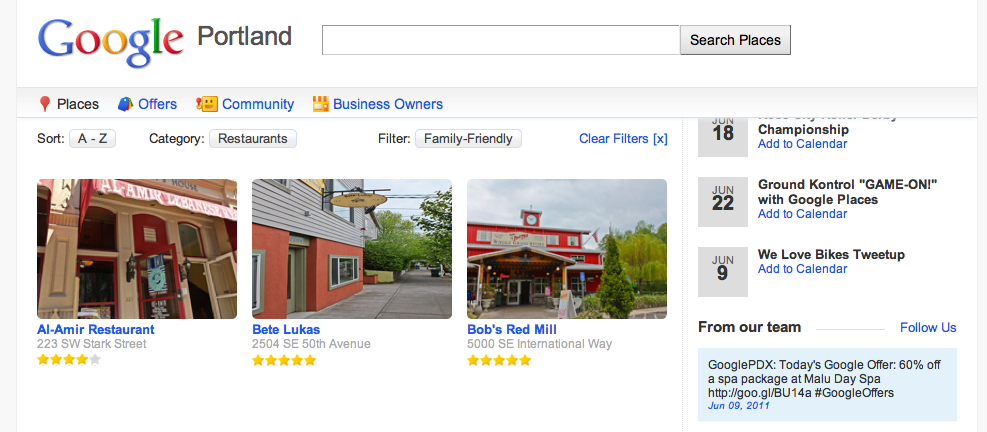
On these sites, you'll be able to browse a list of some of the top businesses recommended by Portland locals by rating, by category ("Restaurant"), and by filter ("Family-Friendly"). Check back often as we'll be continuing to build out this list of places.


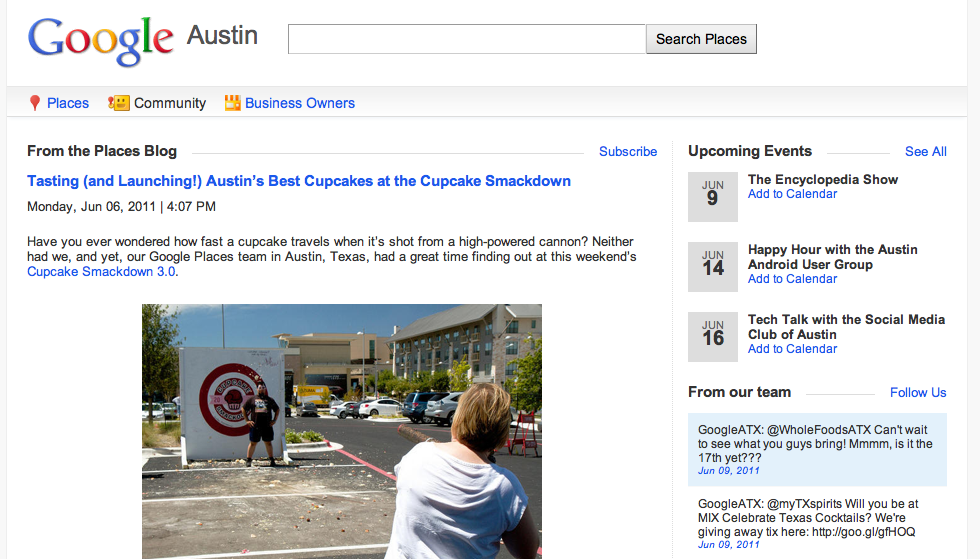
You'll find a page featuring the latest news about the Google Places community, as well as a list of upcoming Google events in that city:


And if you’re a business owner, we've got a special page just for you. Use it as your one-stop-shop to find out how to manage your presence on Google. Bonus: These pages have a fun set of video testimonials from small business owners using Places.


We’ve got big plans for these pages, so stay tuned in the coming months to see what’s new.

Posted by Cecelia Stewart, Local Marketing Team

Google Offers beta launches in Portland, Oregon

(Cross-posted on the Google Places and Google Commerce blogs.)

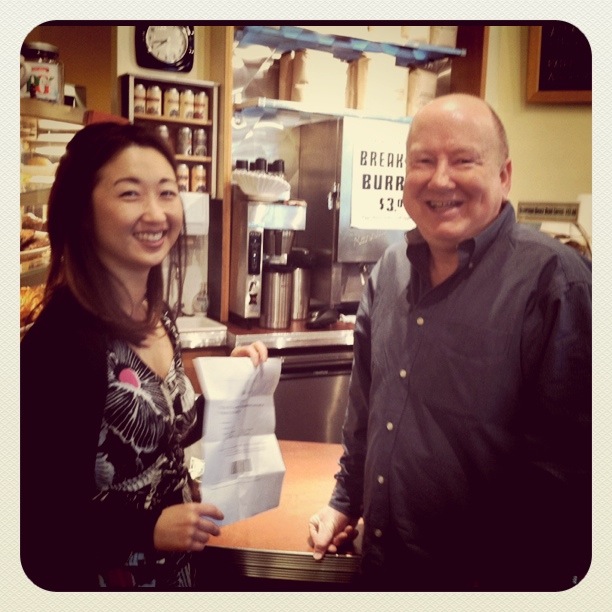
Nothing beats a good deal, and during these couple weeks we saw that first hand. We teamed up with Floyd’s Coffee Shop in Portland to launch the Google Offers beta, a new product that brings Portlanders daily deals from local businesses.

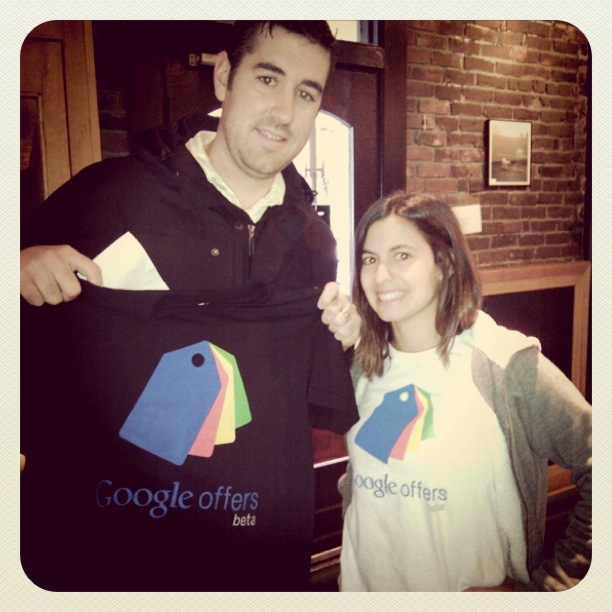
On launch day, we asked Portlanders to sign up for our first deal: $3 for $10 worth of drinks and treats at Floyd’s, a local favorite. And you guys wasted no time! Starting at 7:30 a.m. the following morning, customers rolled in to Floyd’s to redeem and even scored Google Offers t-shirts.


Since Floyd's, we've also had Offers at the Uptown Billiards Club, Karam Lebanese Cuisine and with Le Bistro Montage, Ground Kontrol and Mississippi Studios and Bar Bar. And there are plenty more awesome deals on the way — in Portland and soon in other cities. Subscribe to our e-mails at google.com/offers to learn more about new Portland deals, and to find out when we’re coming to your city. If you’re a business owner who wants to set up an offer, just send us a note.

We’ve had an exciting first couple weeks, and we look forward to many more! Stay tuned to us on Twitter for more news and deals.

Posted by Kim Cianci, Account Manager

segunda-feira, 13 de junho de 2011

Introducing Descriptive Terms in Local Search Results

(Cross-posted on the Lat Long and Google Places blogs.)

Whether it’s to find a great place for dinner or to grab a cup of coffee, I often look up places directly on Google Maps. Evaluating my options and making a choice just got even easier thanks to the list of associated terms that now appears directly in the local search results.

Starting today, Google Maps search results in the U.S. and Great Britain will include some of the phrases which are most frequently used to describe those places. These phrases come from sources all across the web, such as reviews, web pages and other online references, and they can help people quickly identify the characteristics that make a particular place unique. It’s like an opportunity to ask the business owner or its patrons “What’s good here?” or “What do most people get here?”

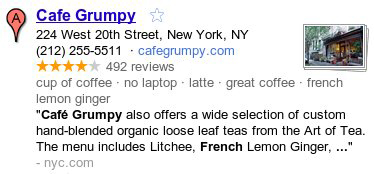
For example, if I’m looking for a place to relax and enjoy a great cup of coffee this weekend, I can see at a quick glance that Cafe Grumpy could be the perfect spot. Besides being known for their “latte” and “great coffee,” they have a “no laptop” policy — exactly what I was hoping for since I’d like to unplug and take a break from work this weekend.


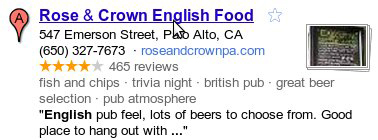
Or if I’m planning to visit friends on the west coast and need to organize a night out, Rose & Crown could be an excellent choice given their “great beer selection” and “trivia night” games on site!


Whether you’re looking for local businesses in your neighborhood or in another city, these descriptive terms can help you find the places right for you. We hope you use these terms to discover new and interesting places on Google Maps, and watch for this feature to appear in Place search on Google.com and Google Maps for mobile soon!

Posted by Manjunath Srinivasaiah, Software Engineer